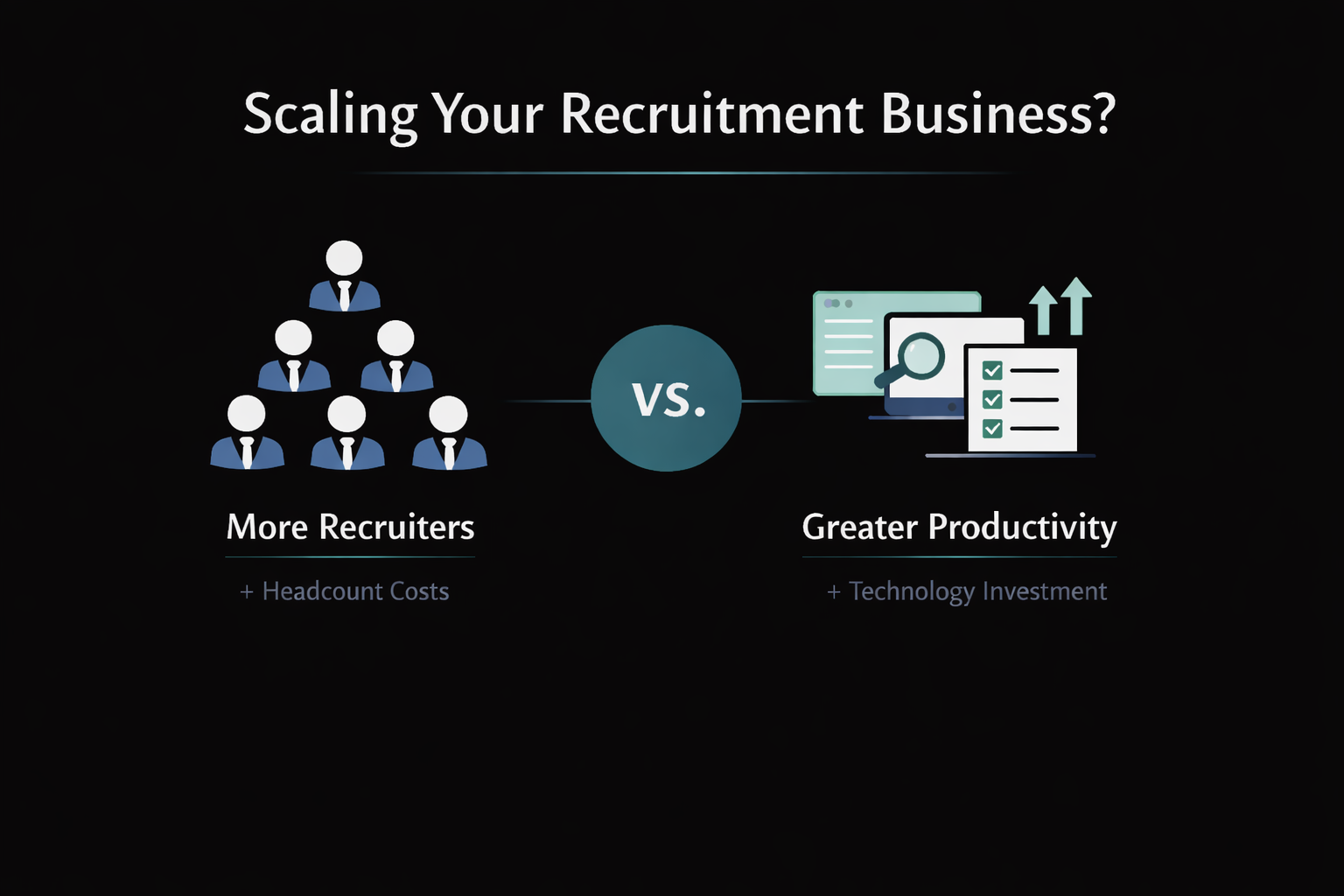
Most recruitment agencies believe they are scaling when they hire more recruiters.
In reality, they are often just increasing costs.
The recruitment industry has traditionally followed a simple formula. Win more clients, receive more mandates, hire more recruiters. The model feels logical because additional recruiters create additional delivery capacity. More capacity leads to more placements, and more placements generate more revenue.
The problem is that revenue growth alone does not mean the business is becoming stronger.
If revenue grows by 30% but payroll grows by 25%, has the agency actually improved? If every new client requires another recruiter, and every recruiter eventually requires management support, the business may be growing in size while remaining fundamentally unchanged in efficiency.
This is why many agency founders find themselves trapped in a cycle where growth feels increasingly expensive. Every revenue milestone comes attached to another salary, another commission structure, another on-boarding process, and another layer of operational complexity.
The agency is not scaling. It is adding weight.
The Metric That Actually Matters
Recruitment businesses have traditionally measured success through activity and output. Placements, billings, interviews arranged, and jobs filled are often used as indicators of performance. While these metrics matter, they rarely tell the full story.
For many SME recruitment agencies serving tech startups, product companies, SaaS businesses, and GCCs, a recruiter billing ₹15 lakhs to ₹30 lakhs annually is often seen as successful. The real measure, however, is not just revenue generated, but how efficiently it is delivered.
This is where recruiter ROI becomes a more meaningful measurement.
The real question is not how much revenue a recruiter generates. The real question is how much revenue the business generates relative to the cost of delivering that revenue.
Two agencies can produce identical turnover while operating with completely different levels of efficiency. One may require ten recruiters to achieve the result. Another may achieve the same outcome with six. Revenue looks identical on paper, but profitability tells a very different story.
The Dependency Problem Nobody Talks About

Headcount-driven growth creates another challenge that is rarely discussed.
The agency becomes dependent on people rather than systems.
Every recruitment founder has experienced it. A top performer resigns and revenue drops. A recruiter takes leave and delivery slows down. A new hire takes months to become productive. Valuable candidate relationships exist inside personal inboxes, spreadsheets, and recruiter memory rather than inside the business itself.
As the agency grows, this dependency becomes more dangerous.
The founder believes they are reducing risk by hiring more people. In reality, they are often multiplying the number of variables that can affect performance.
A business that relies entirely on recruiter effort will always face limitations because recruiter capacity is finite. There are only so many conversations, candidate reviews, and sourcing activities one person can complete in a working day.
Eventually, growth becomes constrained by human bandwidth.
The Shift Smart Agencies Are Making
The most profitable agencies are rethinking growth.
Instead of asking how many recruiters they need to hire, they ask how much more output their existing team can generate.
Rather than adding headcount, they focus on removing friction—reducing repetitive work, eliminating duplicated effort, and helping recruiters spend more time with candidates and clients.
The goal is simple: ensure recruiter time is spent on high-value activities.
Every hour spent searching for information or completing manual tasks is an hour not spent building relationships, winning business, or making placements. Over time, those inefficiencies become a significant hidden cost.
What Scalable Growth Actually Looks Like
A scalable recruitment business is not one that continuously adds recruiters as revenue increases.
A scalable recruitment business increases revenue faster than it increases operating costs.
That distinction matters.
One model grows through additional labour. The other grows through operational leverage. One becomes increasingly dependent on hiring. The other becomes increasingly efficient.
This is why the agencies that will outperform over the next decade are unlikely to be those with the largest teams. They will be the agencies generating the highest revenue per recruiter, the strongest margins, and the greatest operational efficiency.
Growth should not be measured by how many recruiters sit on the payroll.It should be measured by how effectively the business converts recruiter effort into revenue.
That is the metric founders should be optimising.
Because in the long run, the agencies that succeed will not be the ones that hired the most recruiters.
They will be the ones that built the most efficient, resilient, and scalable way to deliver recruitment.